
What an Airsoft Battery Label Actually Tells You
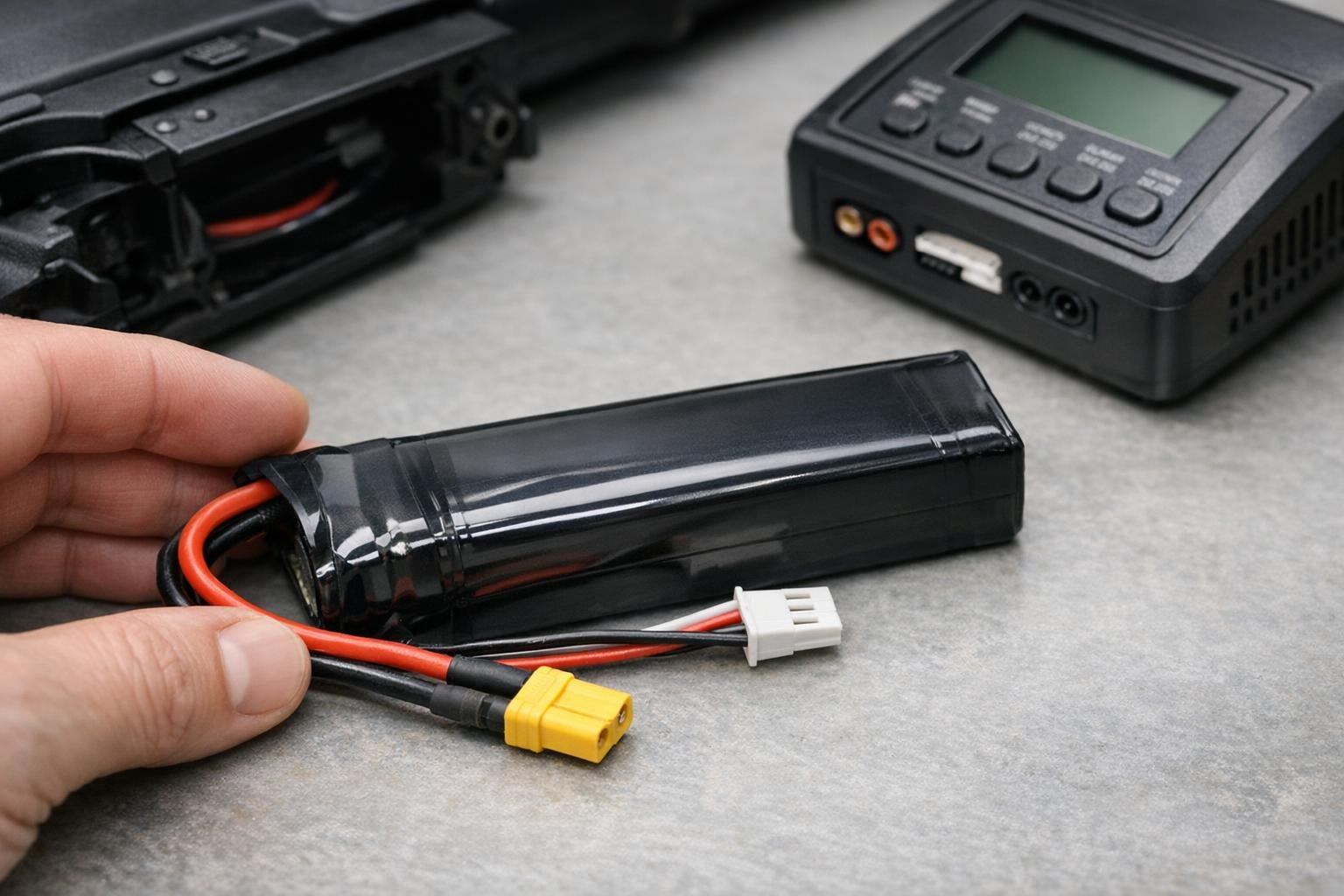
A battery label contains so much information! The name of the charger, the amount of energy a battery can hold, and the amount of current a battery can deliver. Most importantly, however, the label must indicate if a certain battery is suitable for a certain airsoft AEG. So before you go to play some airsoft, always read the label on your battery first. And treat the label like a checklist: first check the type of chemistry, then the voltage, the capacity, the discharge information, the connectors, and finally check the battery for any physical damage.
Start with the chemistry, not the colour
First we look at the label to determine the type of battery it is. LiPo and NiMH batteries are charged in completely different ways. Therefore a charger that is designed for example for LiPo batteries is not automatically suitable for charging NiMH batteries as well.
Most LiPo packs have on them some indication of the number of cells and their nominal voltage (e.g. 3S2P, 4S1P, etc.). In most cases LiPo packs will also require a charger that has a LiPo mode and balancing facility. Where balance leads are connected to the pack (usually by a secondary connector), make sure that these are connected to the charger as well.
On NiMH packs the nominal voltage of the battery is almost always specified, along with the capacity. This ensures that NiMH packs are used with the correct charger for their type of cells. When a pack is being labeled and the label is missing, is unreadable, or does not match the settings on your charger, establish the chemistry of the pack first.
But warning a LiPo battery by pouch color, by the type of connector used, or by other means than other players using the same battery does not guarantee that you choose the correct battery for your Airsoft gun.
Voltage must match the AEG's needs
However, the voltage of a battery pack alone is not sufficient to define a suitable battery for airsoft guns. In addition to the nominal voltage of a pack, the actual number of cells (e.g. as noted on the label as a cell count) must also be considered to ensure the correct configuration of voltage and number of cells for a particular gun. Note, that different manufacturers of airsoft guns have different requirements for voltage and number of cells.
Note that the specifications for voltage of battery and airsoft gun have to match. If an airsoft gun was designed for 9.6V then a 12V battery will increase stress on many internal parts of gun. Also worn wiring, a tired motor, damaged connectors or an unknown internal setup of your airsoft gun means you should pick more conservative set of batteries for it.
When bad things start to happen, like inaudibly loud electrical noise, an overheating connector or maybe even excessive heat in the motor, a very sharp (almost surgical) drop in performance or worse – the notorious "airsoft-chicken Dance" – of sudden loss of power (cycle ends prematurely), you better disconnect the battery or even the whole system quickly (let it cool off first to avoid any accidents or further damage) and figure out what caused it.
Capacity explains endurance, not power
A battery's capacity is expressed in milliamp-hours (mAh) and gives an indication of how long the battery will last in a given scenario. As a rule, a higher capacity does not mean a more powerful AEG, but rather that the player will have to be aware of the larger battery in terms of size and weight. It is also very important to check whether the battery will fit into the battery compartment of the replica in a proper and safe manner.
When considering the capacity of a LiPo battery it is also important to remember the overall size of the battery and how it will fit into your airsoft replica's battery compartment. A higher capacity battery is of little use if the battery is going to be crushed into the stock, sharply bent or even pressed against moving parts. Always check the battery compartment with the battery switched off and make sure that any wires will not be pinched when the stock etc is closed.
Causes of a low runtime could be that the pack is aging off, that your charger does not complete a full charge cycle, that there is some resistance in the connector or that your AEG is drawing more current due to wear and tear or even fault, and that a higher capacity pack will not solve these issues.
C-rating needs context
The C-rating from a LiPo pack label should not be confused with a score for the number of shots in a pack's battery life. The numbers have to be compared within the boundaries of a pack's quality, wires' cross-section, and the AEG's power demand. In practical terms, a label's rating should not be used to choose a battery.
However, a high C-Rating does not mean that you can be bad in maintenance. A loose connection, thin wire, bad soldering, worn motor parts etc. can still cause problems due to voltage drop. Faint trigger, strange motor sounds, warm connectors etc. all point to a problem elsewhere in your setup. So, don't just look at the C-Rating on the label!
This printed label is likely to be inaccurate in some way. It is best to cross reference this with your AEGs documentation, as well as the charger itself to ensure the correct settings are used. In general it is best to physically check the battery against the AEG and the charger before use to prevent errors.
Warning signs that should end the session
Besides the earlier mentioned symptoms, some other symptoms of worn or even broken batteries are: Swollen LiPo-pouches, torn outer wrapping, open or even broken batteries with exposed cells, broken balance lead, broken or torn battery-connector. Do not try to pierce or even squeeze a swollen battery, do not try to open up a damaged battery for repairs with some DIY tools and parts.
Heat of any sort is bad and you should immediately stop using the pack when it starts to get hot, begins to change shape, gets a strange smell, or starts to act abnormally in any way. Charge batteries with the correct charger in a safe manner, and never, ever leave a charged battery to its own devices for long periods of time near flammable materials, etc.
Before storing it away, make sure the charging cable and leads are also in good condition. If you cannot read the label or do not know the history of your battery, it is better to discard it and purchase a new one.
It only takes a few seconds to find out the chemistry, voltage, capacity, C-rate and connector of a battery. In comparison to the risk of being left in the field with a weak setup, or with damage to the AEG or even a charging hazard, all the information you need to set up your battery safely is printed on the label. Use it to match up the information with your AEG, your charger and the battery itself, and remember to always check for the latest manufacturer requirements and relevant safety advice.